Context
The Milky Way Center hosts powerful multiphase outflows, as evidenced by the Fermi and eROSITA bubbles and by cold atomic hydrogen (HI) clouds detected up to several kpc above the Galactic disk, some of them even exhibiting molecular gas (Di Teodoro et al. 2020). However, the physical mechanisms driving these outflows remain debated. In particular, it is unclear whether they are primarily powered by star formation or active galactic nucleus (AGN) feedback.
The Galactic Center is an extreme environment, where gas accumulates in a dense ring-like structure known as the Center Molecular Zone (CMZ), which triggers intense star formation. However, the corresponding star formation activity has been relatively quiet recently, so that it is not clear whether star formation and the subsequent stellar feedback alone can launch winds powerful enough to explain the outflows observational tracers. Concurrently, the central supermassive black hole, SgrA*, is also not particularly active currently, however a possible past activity could have contributed to the present-day outflows.
My work
I used the MHD code PIERNIK to develop a self-consistent, high-resolution model of the MW central region, focusing on outflows driven by stellar feedback (in the form of kinetic and thermal energy, without cosmic rays) in the Central Molecular Zone. The simulation achieves parsec-scale resolution, capturing both the extreme interstellar medium conditions within the CMZ, including gas inflows along the Galactic bar's dust lanes, and the multiphase outflows that develop from it.
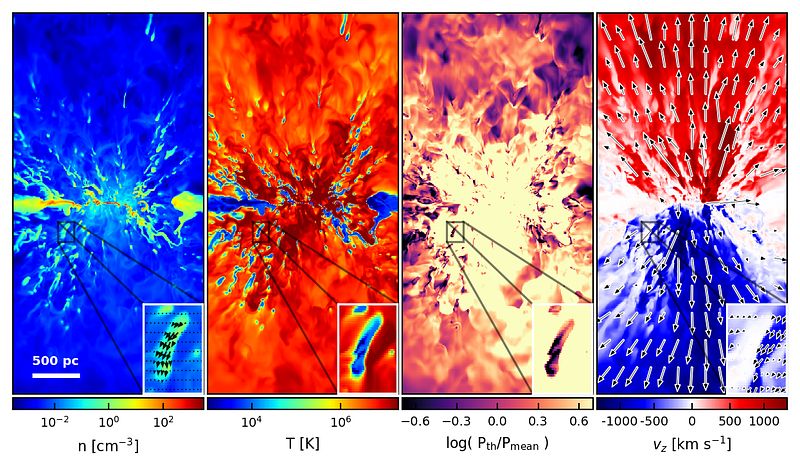
The interplay between gas inflows along the bar's dust lanes and stellar feedback drives cyclic star formation, with starburst episodes separated by quiescent phases. This variability produces powerful, episodic outflows and galactic fountains, with a fast (~1000 km/s), hot wind (~10^6 K) at the center, which accelerates cold (~10^4 K) clouds to velocities of a few 100 km/s, up to 2 kpc heights. These cold clouds are very similar to the HI clouds found in the Milky Way central outflows. These results are described in Peschken et al. (2026), and videos can be found here.
Direct comparisons with observed HI clouds are not straightforward, however, because their inferred properties depend on observational effects. By generating mock HI observations of my simulations, I investigated how these effects, particularly beam smearing and noise, affect the properties of simulated clouds (Peschken et al., submitted). Under realistic observing conditions, over 80% of the clouds remain undetected, while those recovered have underestimated masses and column densities and appear less elongated and less turbulent.
Accounting for these effects, the simulated HI cloud population broadly agrees with observations from the Green Bank Telescope (GBT), although the simulation lacks the highest-velocity and highest-latitude clouds. This suggests that stronger or additional feedback may be needed to reproduce the full range of observed cloud properties and their spatial distribution. Mock observations of UV absorption and soft X-ray emission support this interpretation. The simulated UV column densities lie at the low end of the observed range, while the mock X-ray maps reproduce eROSITA-like bubbles but have too low emission measures.
[Picture]
From Peschken et al. (2026), simulation slice zoomed onto the Milky Way center seend edge-on. From left to right: density, temperature, normalized pressure, and vertical velocity.
[Picture]
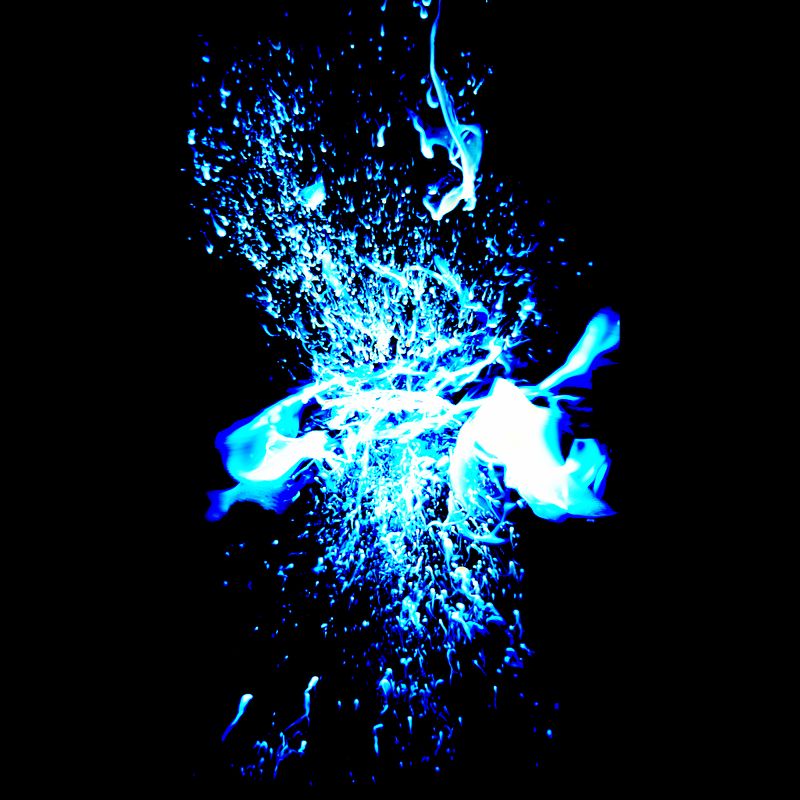
Volume rendering of the HI content in the simulated Milky Way center, showing numerous outflowing cold HI clouds.